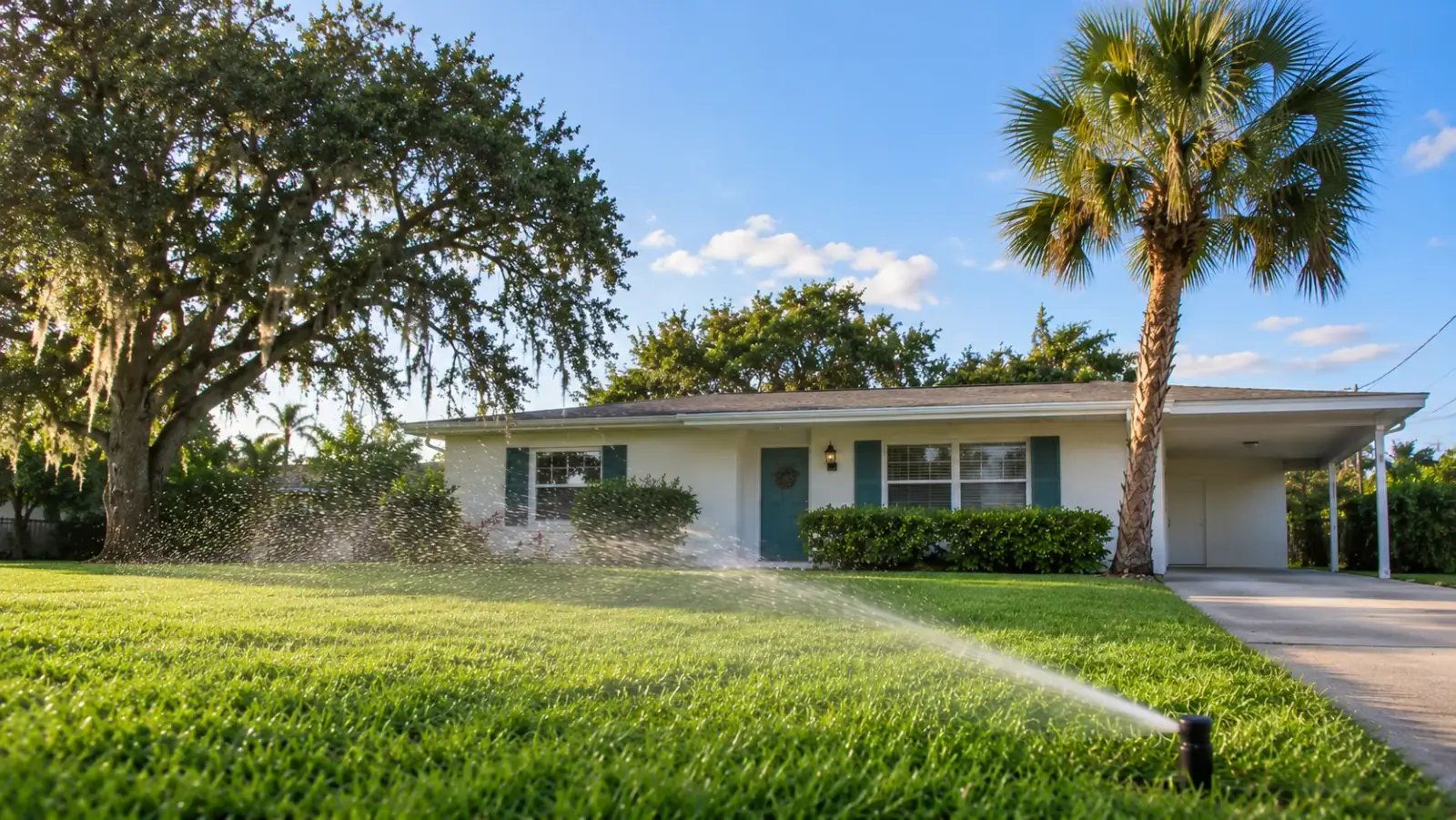
Home Sprinkler Repair in Titusville, FL
Dry patches, a geyser at the curb, a zone that just sits there. We track it down and fix it right.
Most sprinkler problems look bigger than they are. A brown strip along the driveway usually comes down to one clogged nozzle or a head that sank into the sand. A zone that won't turn on is often a single bad wire splice in the valve box. The trick is finding the cause instead of guessing, and that is where we start every visit.
A quick definition, since we use the word a lot: a zone is a group of sprinkler heads that run together off one valve. Your controller turns zones on one at a time. When one zone acts up and the rest work fine, the problem lives somewhere on that one circuit, and we follow it from the controller to the last head.
When it's time for sprinkler repair
- Brown or crispy patches while the rest of the lawn stays green
- A zone that never turns on, or one that never shuts off
- Water bubbling up from the ground or pooling near a head
- Heads that stay buried, tilt sideways or spray the house
- A water bill that jumped with no change in your schedule
- Weak, misty spray or a hissing sound at the valve box
How we handle it
- 01
Zone-by-zone test
We run each zone from the controller and walk it, watching every head for spray pattern, height and reach.
- 02
Pinpoint the fault
Low pressure, a cracked lateral line, a stuck diaphragm or a broken wire. We find the one thing actually causing it.
- 03
Quote, then repair
You get the price before we pick up a shovel. Once you approve it, we make the repair with matching parts.
- 04
Re-test and tune
We run the zone again, adjust arcs and distances, and check that your timer matches your watering days.
Local conditions in Titusville & North Brevard
Titusville sits on fast-draining sand. That is good for drainage and hard on sprinkler heads. Sand shifts around heads after heavy rain, so they lean, sink or end up shooting into a hedge instead of across the lawn. Sand also finds its way into nozzles and filter screens whenever a line breaks or a head gets replaced, so we flush lines before putting a new nozzle on.
Close to the Indian River, salty air works on anything metal. Brass fittings turn green, wire connections in valve boxes corrode, and solenoids fail sooner than they would inland. When a zone quits near the water, the valve box is the first place we open. We replace corroded splices with waterproof, gel-filled connectors so the fix lasts longer than the last one.
What usually causes it
Lawn equipment is the number one cause of broken heads. A mower wheel or an edger catches a head that sits a little too high, and the riser snaps. Next in line is age. Plastic gets brittle in years of Florida sun, seals wear out, and pop-up heads stop retracting because sand has packed into the gap around the stem. A head that stays up gets hit again, and the cycle repeats.
Underground, the usual trouble is a cracked lateral line, the smaller pipe that runs from the valve to the heads. Roots push on it, settling soil bends it, and a careless shovel finishes it off. The clue is often a soft, soggy patch or a zone where the far heads barely pop up. We follow the pressure to find the break instead of digging up the whole run.
Valves fail in quieter ways. Debris lodges under the diaphragm and the zone won't shut off, or a solenoid burns out and it won't turn on. Wiring faults hide in old splices wrapped in tape. Each of these can be tested in minutes once you know which zone to look at, which is why a full zone test always comes first.
A few habits help between visits. Walk each zone once a month while it runs and look for anything spraying the wrong way. Keep grass trimmed back from heads so the spray isn't blocked. After a big storm, check that heads are still standing straight, since saturated sand lets them lean. Small problems caught early stay small.
Sprinkler Repair: what people ask
Why is only one part of my lawn turning brown?
Usually that area is getting less water than the rest. A clogged or mismatched nozzle, a head blocked by grass, a sunken head or a slow leak upstream are the common causes. We check the heads covering that spot first, then work back toward the valve.
Do you repair systems you didn't install?
Yes. Most of our work is on systems someone else put in. We work with all the common head, valve and controller types used in Florida yards.
Can a broken head really raise my water bill?
It can. A head that has snapped off at the riser lets water flow freely every time that zone runs. Over a few weeks that adds up, which is why we suggest walking your zones now and then while they run.
Will you tell me the price before you start?
Always. We explain what we found, what it takes to fix it, and what it costs. Nothing gets dug up or replaced until you say yes.
How long does a typical repair visit take?
Simple repairs like heads, nozzles and small line breaks are often finished on the first visit. Wiring faults and valve replacements can take longer, and we will tell you up front if a second visit is needed.
Often paired with this
Let's talk about your yard
Tell us what's going on and we'll take it from there. Free estimates, and you approve the price before any work starts. Ask about licensing and insurance before any work begins, with us or anyone else.
(321) 382-8298 Text a photo of the problem