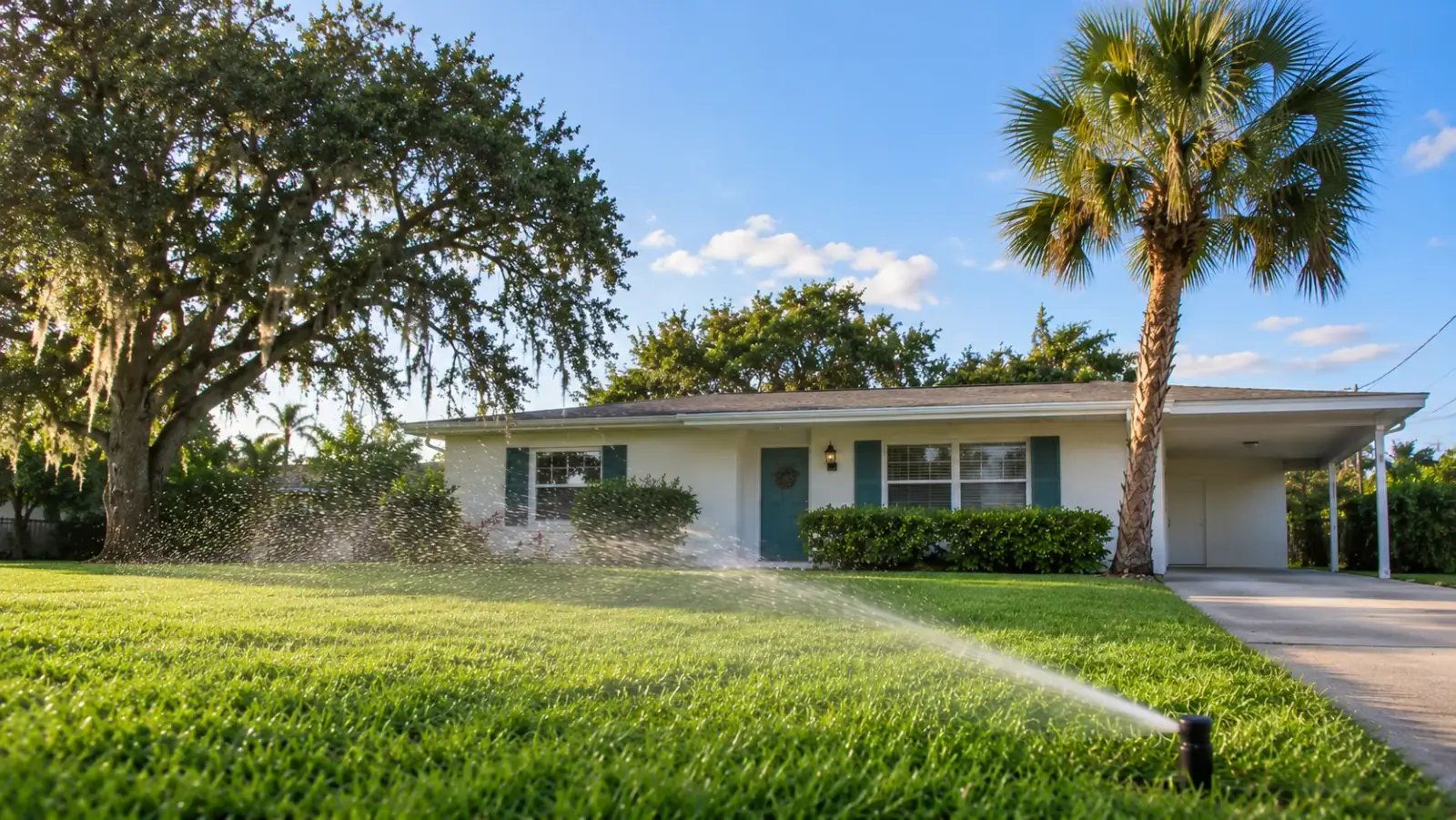
Walk down almost any Titusville street on a watering morning and you will see it: a sprinkler sending a steady arc across the sidewalk, a puddle forming at the end of a driveway, a thin stream running along the curb. That is overspray, water landing somewhere it was never meant to go. It is one of the most common sprinkler problems we see, and one of the easiest to fix.
Why overspray is worth fixing
The obvious cost is wasted water. Every gallon that hits concrete is a gallon your lawn never gets, which is often why the strip of grass next to the driveway is the first to turn brown. You pay for that water, and because watering days are limited by address in Titusville, you can't make up for it by running the system more often.
The less obvious cost is where that water goes. Driveways, sidewalks and streets drain to storm drains. In Titusville, much of that drainage ends up in the Indian River Lagoon. Water that runs off a lawn can carry fertilizer, grass clippings and whatever else is sitting on the surface. A single yard doesn't make or break the lagoon, but a whole neighborhood of sprinklers watering the street adds up. Keeping water on the grass is a small, practical thing every homeowner can do.
Step 1: Watch every zone run
Start at the controller and run each zone one at a time for a few minutes. Walk the zone while it runs. You are looking for three things: water hitting pavement, walls or windows; heads that are tilted, sunken or blocked by grass or shrubs; and spots where water pools or runs off. Take a quick photo or note of each problem. This ten-minute walk tells you more than any amount of guessing.
Step 2: Adjust the arc and distance
Most spray and rotor heads can be adjusted. The arc is how wide the spray pattern sweeps, from a narrow strip to a full circle. The distance, or radius, is how far the water throws. Many spray nozzles have a small screw on top that shortens the throw when you turn it. Rotors usually have an adjustment for both arc and distance. Turning a head that is spraying a quarter of the way into the street back toward the lawn is often all it takes.
One caution: shortening the throw too much with the screw can break up the spray and leave dry rings. If you have to cut the distance a lot, a different nozzle is usually the better fix.
Step 3: Use the right nozzle
Nozzles come in different patterns and throw distances: quarter circle, half circle, full circle, strip patterns for narrow side yards, and more. A head along a driveway edge should usually be a half-circle or a side-strip nozzle, not a full circle. Swapping to the right pattern stops water from landing behind the head on the pavement.
It also matters that nozzles in the same zone put out water at a matched rate. If one head in a zone puts down much more water than its neighbors, part of the lawn gets soaked while another part stays dry. Matching nozzles within each zone keeps coverage even without overwatering.
Step 4: Check the pressure
If spray looks like fog or mist drifting in the wind, pressure is probably too high. Misting water blows onto pavement and evaporates before it reaches the grass. If spray barely reaches past the head, pressure may be too low, often because there are too many heads on one zone or there is a leak upstream. Pressure-regulating heads or a pressure regulator at the valve can fix the first problem. The second often needs a leak repair or a zone split.
Step 5: Fix heads that moved
Titusville's sandy soil shifts around sprinkler heads after heavy rain and with time. Heads end up leaning, sitting too low or pointing in a new direction. A tilted head throws water in a lopsided pattern, and a sunken one sprays into the grass right around it. Straightening a head and resetting it level with the soil, sometimes with a taller riser for thick St. Augustine grass, puts the spray back where it belongs.
Step 6: Rethink the layout
Sometimes the problem is the design. A narrow strip between the driveway and the neighbor's fence may be too thin for spray heads at all. A bed full of grown shrubs will block spray no matter how you adjust it. In those cases, it often makes sense to move heads, split a zone, or convert a bed to drip irrigation, which puts water at the roots and almost never hits pavement. We cover that work on our rerouting and rezoning and drip irrigation pages.
Step 7: Water smarter, not longer
Sandy soil soaks up water quickly but doesn't hold much. Running one zone for a long time can send water past the roots or off the surface. Splitting a run into two shorter cycles on the same watering day, with a break in between, gives water time to soak in. Always stay inside your allowed days and hours. Check yours on our watering days page.
Also make sure your rain sensor works. Florida law requires automatic sprinkler systems to have a device that stops them when there is enough moisture. A system running in the rain is the most obvious kind of runoff there is.
When to call for help
If you have adjusted heads and swapped nozzles and the water still ends up on the driveway, or if fixing one spot leaves another one dry, the layout probably needs work. That is the kind of problem we solve every week. We test zone by zone, show you what we found and give you a price before we change anything. Start with our sprinkler repair service or request a free estimate.
Rules can change. Always confirm watering rules with the City of Titusville and the St. Johns River Water Management District.